
MIAMI GARDENS, FL – The obvious takeaway from this snapshot in time, this clear distinction between what is and what you want it to be, is how much money are the billionaire boosters at Texas Tech willing to spend?
How much more money will it cost to take a magical season for the ages, and push through the stratosphere of competing with the Big Ten and SEC?
Because that’s how far away the highest-paid roster in college football looked from competing with the elite of the sport in Thursday’s humbling 23-0 loss to Oregon in the College Football Playoff Orange Bowl quarterfinal.
Reached shortly after the loss, Texas Tech booster Cody Campbell, the financial architect of this made-for-championships roster, told USA TODAY Sports of the 2026 season, ‘We will double down.’
And there’s your cold, hard truth of an answer. This thing is just beginning at Texas Tech.
The scary thing for Campbell and his billionaire partners from Double Eagle Capital, who fund the Texas Tech NIL Matador Club and spent $25 million on this year’s roster to get the Red Raiders up to speed with the big boys of college football: Oregon isn’t exactly the top of the food chain.
Then again, the Ducks didn’t need to be. They simply had to hang around and let the Texas Tech offense implode to move onto next week’s CFP Peach Bowl semifinal.
‘It’s no fun being in that locker room,’ said Texas Tech coach Joey McGuire, the former legendary Texas high school coach who deftly pieced together this team of West Texas lifers and one-year transfer portal mercenaries. ‘When you do something that’s never been done, the standard is set. That’s when you come back and build something really special.’
The 2.0 buildout for 2026 will begin and end on offense, the unit that sputtered often during the season with an injured quarterback and a shaky offensive line ― but was saved week after week by one of the nation’s best defenses. Those flaws were exposed over and over by Oregon, which kept getting gifts from the Texas Tech offense and eventually converted them into points.
Texas Tech had six turnovers: two interceptions (one in the end zone), two fumbles and two turnovers on downs. The Red Raiders also missed a field goal, lined up offsides on a punt that gave Oregon a first down to extend a drive, and wobbled through six three-and-outs on offense.
The team that won each of its 12 games by at least 22 points, had season lows in total yards (215), rushing yards (78) and explosion plays. Quarterback Behren Morton barely completed 50% of his passes, and the offense was shutout for the first time since 2021.
The Texas Tech pass game averaged a measly 4.3 yards per attempt ― or half of what it averaged during a rare season that included the most wins in school history (12) and the first Big 12 championship in school history.
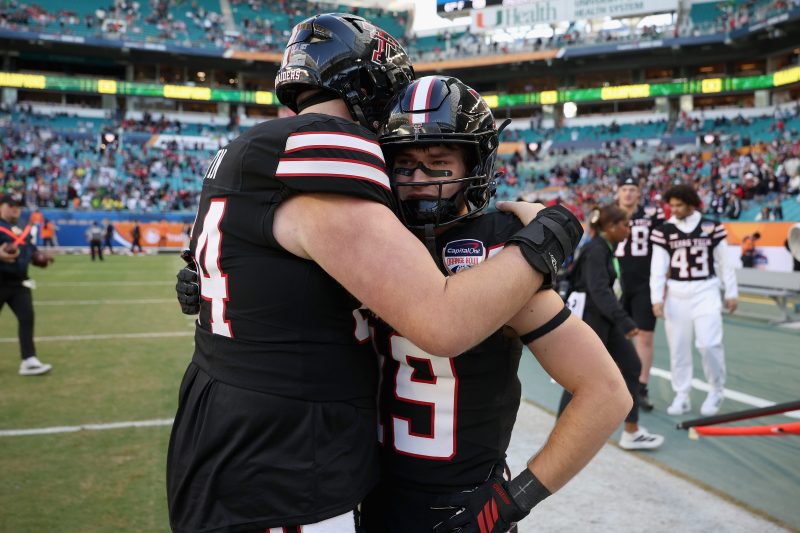
But while Oregon smoked victory cigars in the Hard Rock Stadium locker room and watched the Rose Bowl to see who was next, Morton could barely compose himself in the postgame aftermath. A Lubbock native who battled injuries over his entire career at Texas Tech, he ran off the field with his chin tight to his chest while green and gold confetti fell.
This isn’t how it was supposed to end. It’s more than just a Big Ten or SEC patch on your jersey, it’s the fight in the West Texas dog.
It’s about reeling in the Big Ten and SEC, and showing ― on the big stage for all to see ― what this unique experiment had become in such a short time.
‘I love this university,’ Morton said, pausing to collect himself. ‘I’ve been a Red Raider since I was a little kid. It has been so much fun to put Texas Tech on the map.’
Now here’s the difficult part: defining that map.
The transfer portal opens Friday, and the quick fix rush is on all over the college football landscape. The Red Raiders need a quarterback (Cincinnati’s Brendan Sorsby is a top target), and the offensive line must get bigger and stronger and push around elite teams.
Championship life extends outside the Big 12, and Texas Tech’s ability to stretch its legs and find its stride depends on the financial investment from The Matador Club and McGuire’s continued ability to assimilate one-year guns for hire and what he’s organically building.
Texas Tech has the nation’s No. 18 recruiting class, according to the 247Sports composite rankings, a group that includes six blue-chip signees (two five-star, four four-star) ― four of which are among the top 120 players in the nation.
Not surprisingly, two of those four are offensive linemen, including Felix Ojo, the No.1 offensive tackle in high school football who signed with Texas Tech over Ohio State and Texas. That’s what real financial investment can do.
That’s how Double Eagle’s cash and McGuire and his staff’s development moved Texas Tech from a middling Big 12 team, to a team that now sees itself mirroring Oregon.
A year ago, Oregon ― like Texas Tech, the benefactor of cash commitments from a billionaire booster (see: Nike’s Phil Knight) ― took an unbeaten season into the CFP and were blown out by eventual national champion Ohio State in the quarterfinals.
‘I know how they feel right now,’ Oregon coach Dan Lanning said. ‘It’s no fun.’
But Oregon responded with four critical additions on offense from the portal (three offensive linemen), and four on defense. Guess who won the line of scrimmage Thursday afternoon?
All it needed this time around was a little motivation, and Oregon got it when James Madison scored 34 points on the Ducks in the first round of the CFP. That meant Oregon had given up 75 points in two career CFP games under Lanning and his defense-first mentality.
It’s not hard to see where this was headed.
Oregon was better on the line of scrimmage, and was faster and more athletic. It made Texas Tech’s run-first offense one-dimensional and inadequate at just about everything.
Were it not for a 50-yard run off a broken tackle by Texas Tech’s J’Koby Williams, the Red Raiders would’ve had 28 rushing yards on 29 carries.
“When you get embarrassed like we did defensively, there’s only one response,” Oregon linebacker Bryce Boettcher said.
How fitting. How Texas Tech responds to this embarrassment — by throwing more money at the problem — will go a long way in determining if the Red Raiders are built to last.
Or just a bad investment away from a poor rate of return.